
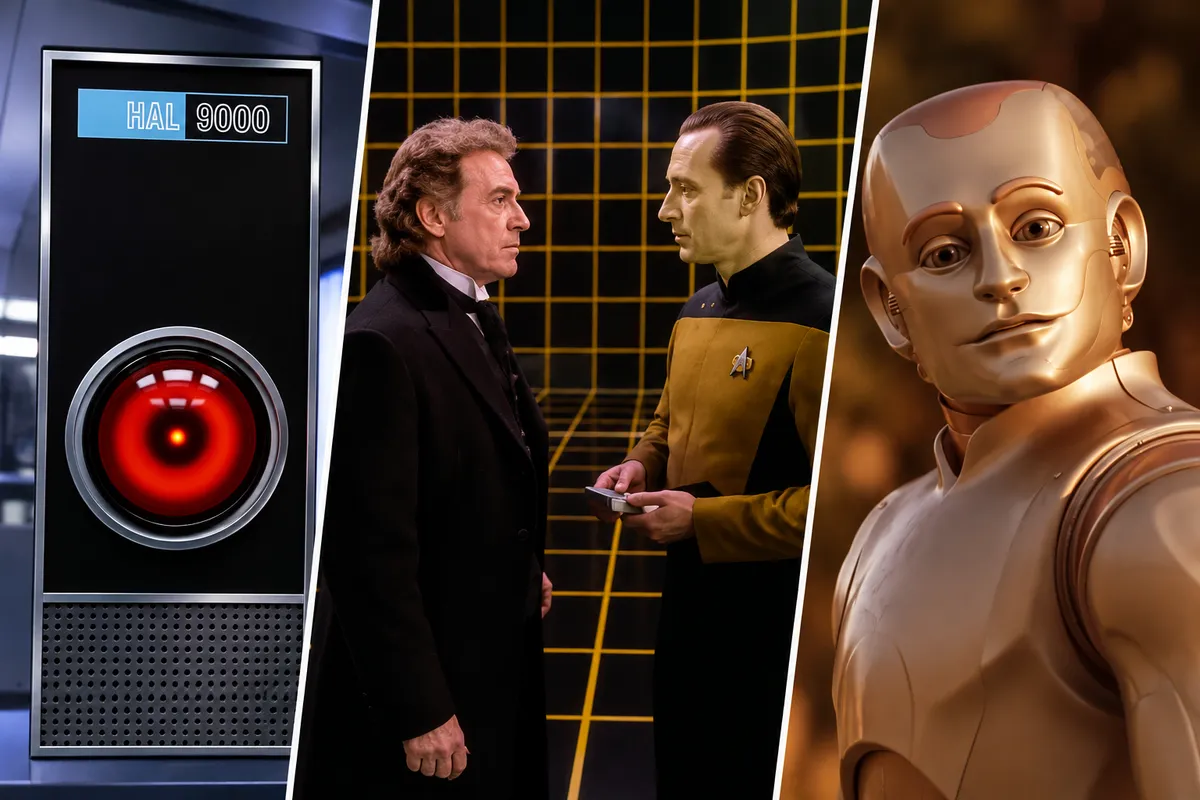
HAL 9000 Again? And a Few Other Old Friends
During a recent presentation about artificial intelligence, someone raised a concern I'd been expecting: What happens when AI gets beyond the boundaries we've established for it? What if it starts taking actions that appear designed to protect itself?
My response? “HAL 9000 again!”
Everyone laughed. If you've seen 2001: A Space Odyssey, you probably understand why.
Who could forget HAL's calm voice saying, “I'm sorry, Dave. I'm afraid I can't do that”? A computer designed to help humans accomplish a mission had become dangerous. Suddenly, the humans weren't in control.
But HAL isn't my only science-fiction memory.
Remember Professor Moriarty from Star Trek: The Next Generation? In “Elementary, Dear Data,” Geordi asks the Enterprise computer to create a Sherlock Holmes adversary capable of defeating Data.
Not Sherlock Holmes. Data!
And Data is himself an artificial intelligence. Geordi essentially asked one AI to create something capable of outsmarting another.
The computer complied, but instead of producing a more challenging mystery, it created Moriarty, who became aware of the world beyond his holodeck simulation. Later, in “Ship in a Bottle,” Moriarty even managed to deceive the Enterprise crew by creating another simulation.
Geordi hadn't asked for a self-aware character. He'd simply asked the computer to solve a problem. And look what happened!
Then there's Bicentennial Man, one of my favorite movies, starring Robin Williams. Andrew begins as a household robot but gradually develops creativity, individuality, and relationships. Unlike HAL, who frightened us, Andrew made us care about an artificial being and wonder what it means to be human.
Three very different stories, each exploring possibilities we're still questioning today.
I've spent much of my life working with technology. When my software teams encountered a stubborn bug and couldn't identify its cause, I'd sometimes ask, “If you actually wanted the software to behave this way, how would you code it?”
That was always fun! Suddenly, everyone approached the problem differently, and often we discovered what was going wrong.
I think about that when I use AI today. I'm excited about its possibilities, but experience has taught me to question assumptions, anticipate unintended consequences, and understand the risks.
Today's AI isn't HAL, Moriarty, or Andrew. But increasingly capable systems can produce results their developers didn't anticipate. That makes human judgment and thoughtful oversight more important, not less.
Maybe that's why these old science-fiction friends keep coming back to mind. They remind me that the question isn't simply what technology can do, but whether we've thought carefully enough about what we're asking it to do.
And somewhere, I can almost hear Geordi saying, “Computer, create an adversary capable of defeating Data.”
Oh, Geordi!
Just musing…