
The Things We Don't Forget
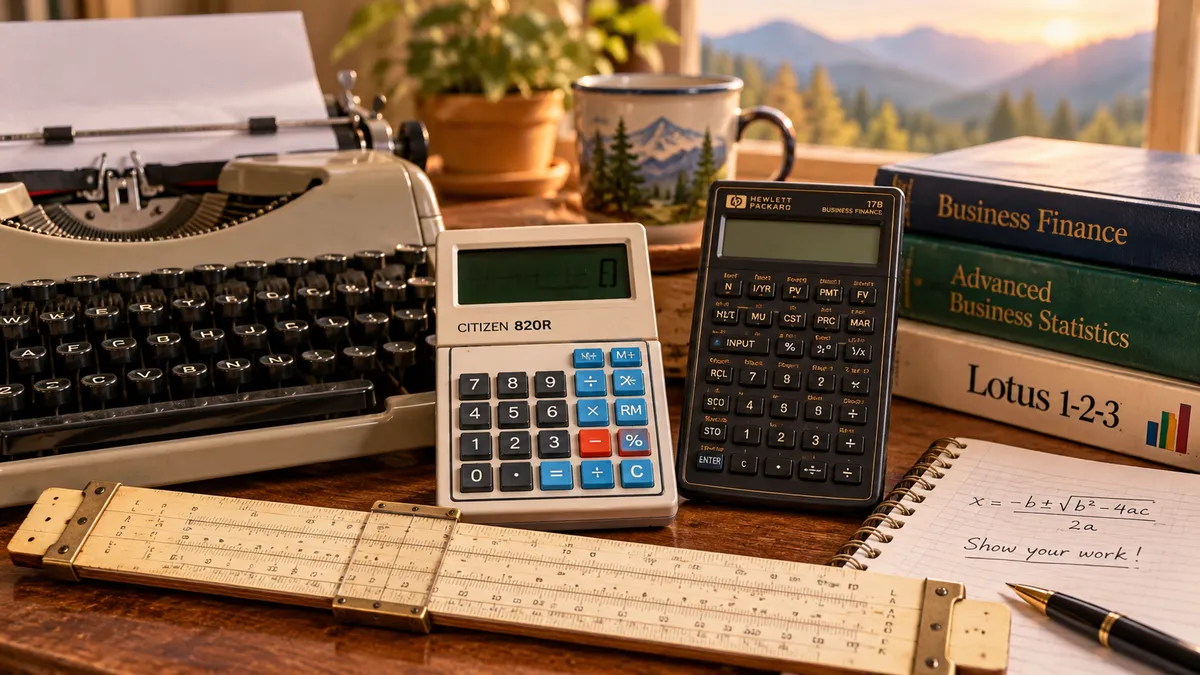
I still have my first calculator. It's a Citizen 820R, and I've had it for more than fifty years. I also still have my HP 17B financial calculator, which takes me back to my college days studying business finance. I suppose some people collect antiques. Apparently, I collect calculators!
When I was in college, the HP 17B and Lotus 1-2-3 were required tools. But there was an interesting rule. We could use the calculator to double-check our answers, not to do the work for us. I particularly remember Advanced Business Statistics, where getting the right answer wasn't enough. We had to show our work and demonstrate that we understood the formulas. I seem to remember wrestling with the quadratic equation, among other things. There were certainly times when I would have been delighted to let the calculator do all the work!
Looking back, I appreciate what our instructors were teaching us. They weren't opposed to technology. After all, they required us to learn how to use it! But they wanted us to understand what we were doing, not simply know which buttons to push.
And those skills didn't disappear when better tools came along. I still know how to add, subtract, multiply, and divide without a calculator. I don't own a typewriter anymore, but my fingers still know where the keys are. Today I can type on a computer, dictate using Dragon, or swipe words onto a screen. And I can still drive a stick shift! Apparently, that's becoming something of a novelty. Who would have thought?
All of this got me thinking about the conversations we're having today about artificial intelligence. Will AI make us forget how to write, research, solve problems, or even think for ourselves? Those are reasonable concerns. Skills we don't practice can certainly get rusty. But I wonder whether we're asking quite the right question.
Perhaps what matters isn't whether we use technology, but how we use it. When I use a calculator, I still need to recognize whether the answer makes sense. When I use AI, I want to question what it tells me, explore possibilities, and make my own decisions. I don't want it to replace my thinking. I want it to help me think.
More than fifty years after buying that first Citizen calculator, I think my college professors had the right idea. Learn to use the tools, but don't give up understanding what you're doing.
Meanwhile, I'm keeping both calculators. And if someone ever needs a driver who knows how to operate a clutch, I'm available!
Just musing…